
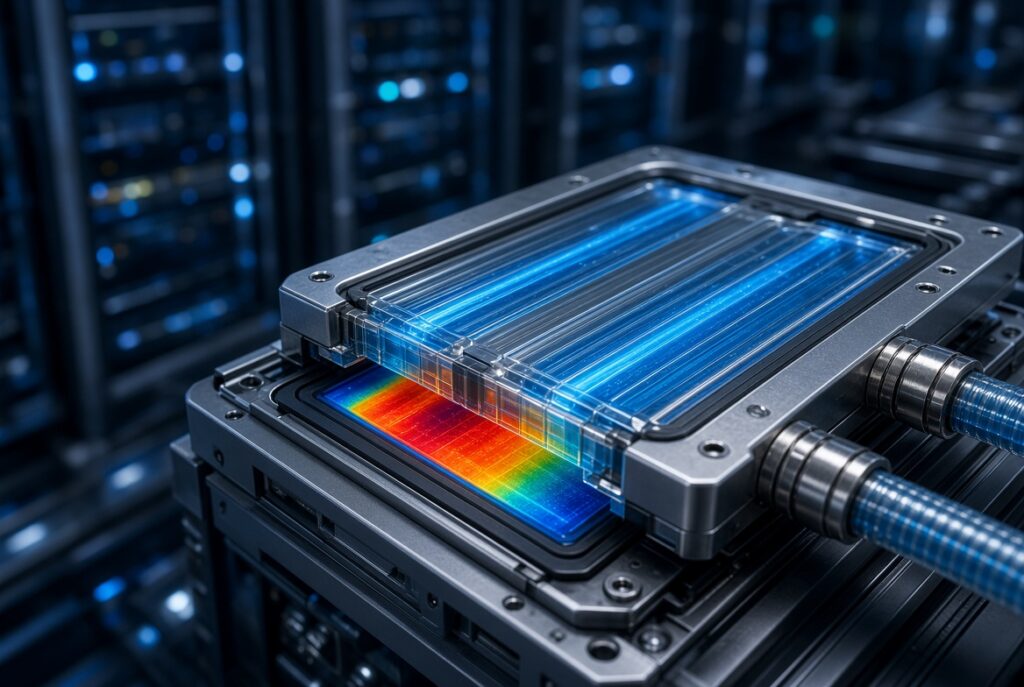
As AI accelerators push power densities well beyond the practical limits of air cooling, direct-to-chip liquid cooling has moved from specialized applications into mainstream data-center and high-performance computing design. When executed well, it delivers lower operating temperatures, improved energy efficiency, higher rack density, and greater system reliability. When executed poorly, it introduces new risks around leakage, thermal non-uniformity, and long-term reliability.
This article outlines the key design considerations that separate robust, production-ready direct-to-chip solutions from those that struggle in the field.
Why Direct-to-Chip Cooling Is Becoming Essential
Modern AI GPUs and accelerators routinely dissipate several hundred watts to well over a kilowatt per device. At these levels, traditional air cooling becomes inefficient, noisy, and increasingly unable to maintain acceptable junction temperatures without aggressive throttling. Direct-to-chip cold plates remove heat at the source, dramatically reducing thermal resistance between the silicon and the coolant.
The benefits are clear:
- Higher sustained performance
- Lower facility-level energy use (improved PUE)
- Greater compute density per rack
- More predictable thermal behavior under varying workloads
However, realizing these benefits requires careful attention to several engineering details that are often underestimated.
Critical Design Considerations
- Cold Plate Thermal Performance and Uniformity. The cold plate must deliver both low thermal resistance and uniform temperature distribution across the die. Microchannel or micro-pin fin designs are common, but channel geometry, flow distribution, and contact quality with the package all influence results. Non-uniform cooling can create hotspots that limit overall performance even if average temperatures look acceptable.
- Coolant Selection and Compatibility. Single-phase water-glycol mixtures remain the most common choice for data-center applications because of their heat capacity and relatively straightforward system design. Dielectric fluids open the door to immersion or two-phase approaches but introduce different material compatibility, pumping, and filtration requirements. Material selection for cold plates, fittings, and seals must be validated against the chosen fluid over the expected operating temperature range and lifetime.
- Flow Distribution and System Hydraulics. In multi-accelerator systems, ensuring even flow to every cold plate is critical. Poor manifold design or unequal pressure drops can leave some devices under-cooled while others receive excess flow. System-level hydraulic modeling, combined with careful manifold and connector design, is essential for scalable deployments.
- Interface and Mechanical Integration. The thermal interface between the package and cold plate remains one of the highest thermal resistances in the stack. Surface flatness, contact pressure, TIM selection (or direct bonding approaches), and mechanical retention all affect long-term performance. Warpage of large packages under thermal cycling further complicates reliable contact.
- Leak Prevention and Serviceability. Any liquid system carries the risk of leaks. Robust connector design, proper torque specifications, quality control of assemblies, and thoughtful routing that avoids stress on fittings are non-negotiable. Serviceability must also be considered — cold plates and manifolds should be replaceable without excessive downtime or risk to neighboring hardware.
- Validation Beyond Steady-State Simulation. High-fidelity CFD is valuable, but it is not sufficient on its own. Transient behavior under realistic AI workloads, thermal cycling, coolant aging, and long-term reliability testing are required to build confidence. Reduced-order models and digital twins can help bridge the gap between detailed simulation and real-time monitoring once systems are deployed.
From Design to Reliable Deployment
Successful direct-to-chip implementations treat the cooling solution as a full system rather than a collection of components. This means aligning cold-plate design with package characteristics, coolant chemistry, facility constraints, and operational procedures from the earliest stages.
Teams that invest in rigorous multiphysics simulation, physical prototyping, and structured validation are far more likely to deliver solutions that perform as predicted and remain reliable over years of continuous operation.
Closing Thought
Direct-to-chip liquid cooling is no longer experimental — it is becoming a practical necessity for the highest-power AI systems. The difference between a successful deployment and a problematic one usually comes down to how thoroughly the details of thermal performance, fluid compatibility, hydraulics, mechanical integration, and validation are addressed.
About HeatSync
HeatSync is a Silicon Valley–based thermal engineering firm specializing in advanced air and liquid cooling solutions for electronics and battery systems. With nearly 150 years of combined experience, our team delivers end-to-end thermal design — architecture, simulation, digital twins, virtual sensors, and prototyping — for applications ranging from consumer electronics and EV batteries to AI servers and data-center infrastructure. Equipped with a full prototyping and reliability lab, HeatSync provides high-fidelity CFD modeling, multiphysics analysis, immersion and two-phase cooling development, thermal-mechanical validation, and performance optimization.