
Executive Summary
Active air-cooled thermal solutions are widely used in servers, networking gear, consumer electronics, and energy storage systems due to their simplicity, cost efficiency, and high reliability. However, acoustic noise remains a key challenge. This blog highlights effective engineering strategies—ranging from optimal fan selection to system-level airflow optimization—that reduce noise while preserving thermal performance. These approaches enable quieter devices, improved user experience, and more efficient cooling across a wide range of electronic applications.
1. Introduction
The prevalence of active air-cooled thermal solutions is extensive, with applications spanning electronic equipment such as servers, switches, central office, data center equipment, as well as in consumer electronics and energy storage systems. While the utilization of Air Active cooling has gained prominence due to its numerous advantages, it is not without its challenges. One noteworthy concern revolves around the acoustic noise generated during the cooling process. This article will provide a concise exploration of the strategies employed to mitigate acoustic noise in active air-cooled systems.
2. Strategies for Acoustic Noise Reduction
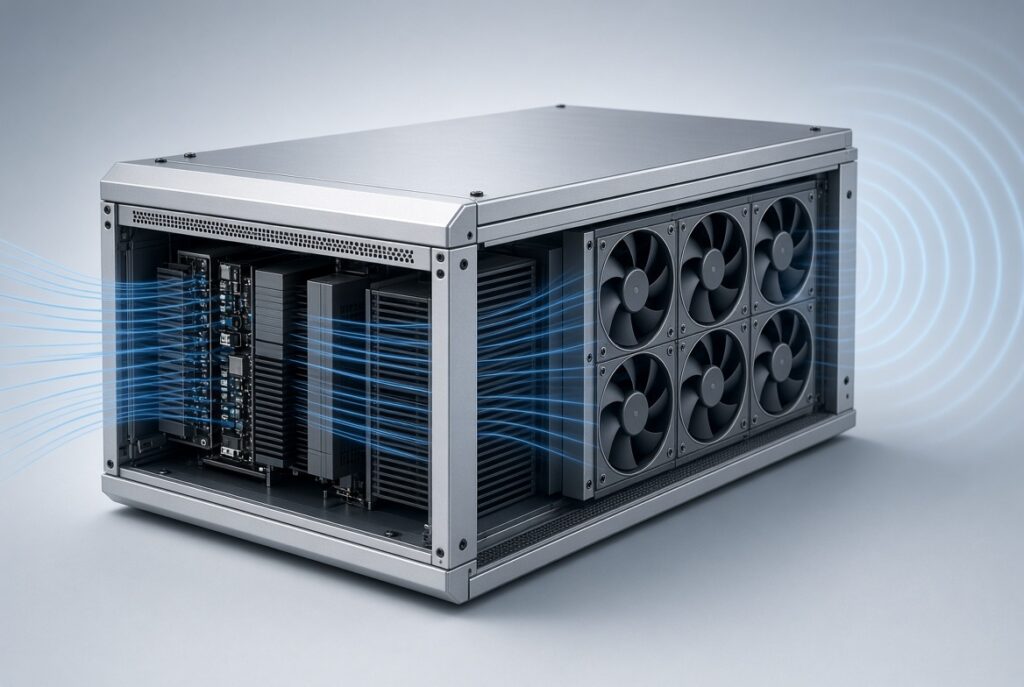
• Optimal Fan Selection: Utilizing a larger diameter, lower speed fan can markedly contribute to noise reduction. This approach strikes a balance between effective cooling and minimizing the disruptive noise generated during operation.
• Multiple Fans for Reduced Speed: Strategically employing multiple fans to distribute the cooling load enables a reduction in individual fan speed. This leads to a quieter operation without compromising on cooling efficiency.
• Dynamic Fan Speed Control: Implementing fan speed control systems can be transformative. Adjusting fan speed according to actual cooling demands not only conserves energy but also maintains a quieter operational environment during periods of lower airflow requirements.
• Clear Airflow Paths: Ensuring unobstructed inlet and outlet paths is crucial. Obstacles in these paths can disrupt airflow, leading to increased noise levels. This is particularly critical on the inlet side of the system.
• Optimize Airflow Design: Minimizing sharp bends in the airflow path near the fan’s inlet and outlet enhances efficiency and contributes to an overall quieter system.
• Internal Fan Placement: Positioning fans on the interior of the system, rather than on the chassis walls, helps contain and dampen noise within the device.
• Sound Dampening Materials: Incorporating sound-dampening materials on the interior of the chassis absorbs and mitigates noise, creating a more acoustically comfortable environment.
• Axial Flow Fans: Opting for axial flow fans instead of blowers, when appropriate, provides effective cooling with lower noise levels, meeting static pressure requirements.
• Operating Point Optimization: Ensuring the fan operates in the region of maximum efficiency, while avoiding the stall region, not only improves performance but also minimizes noise generation.
• Vibration Isolation: Employing elastomeric, energy-absorbing fan mounts isolates vibrations from the chassis, preventing them from translating into audible noise. This further enhances the acoustic comfort of the system.
3. Conclusion
In conclusion, the quest for efficient thermal management doesn’t have to come at the cost of acoustic comfort. By implementing these strategies, we can strike a balance between effective cooling and a quieter operational environment, meeting the demands of both functionality and user experience in various electronic applications.
About HeatSync
HeatSync is a Silicon Valley–based thermal engineering firm specializing in advanced air and liquid cooling solutions for electronics and battery systems. With nearly 150 years of combined experience, our team delivers end-to-end thermal design—architecture, simulation, digital twins, virtual sensors, and prototyping—for applications ranging from consumer electronics and EV batteries to AI servers and data-center infrastructure. Equipped with a full prototyping and reliability lab, HeatSync provides high-fidelity CFD modeling, multiphysics analysis, immersion and two-phase cooling development, thermal-mechanical validation, and performance optimization. We help companies accelerate innovation and build reliable, manufacturable, and energy-efficient thermal management systems.
Tags
acoustic noise reduction, air-cooled thermal solutions, fan noise mitigation, airflow optimization, axial fan design, vibration isolation, thermal engineering, CFD airflow modeling, electronics cooling, HeatSync insights